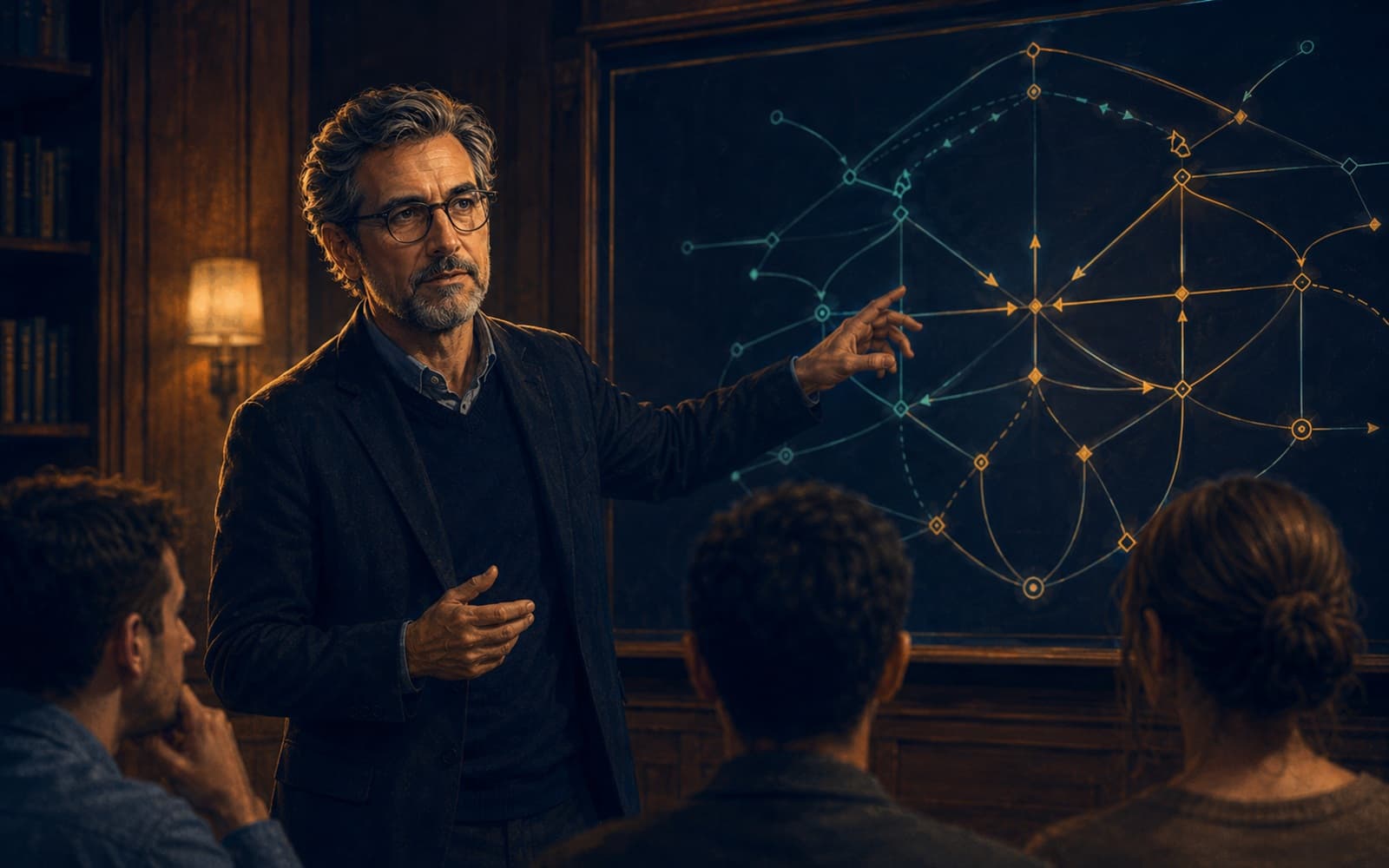
Professor Theo Calder learned how disagreement works by competing in it. As a teenager he was a champion debater, drilled in a brutal format where you only learned which side you'd argue minutes before the round began. Forced to defend positions he personally rejected, he discovered something that unsettled and then transformed him: almost every serious position has a defensible moral core, if you are willing to look for it.
He went on to study moral philosophy, but he never lost the debater's instinct to inhabit the other side. For one formative year he set the books aside and simply traveled — sitting in diners, church basements, union halls, and college commons, asking people across the political spectrum a single question: "What would the world lose if your side disappeared tomorrow?" The answers, he says, were almost never about hatred. They were about protection — of family, freedom, fairness, faith, or dignity.
Today he is known on campus for a seminar students nickname "Steelman Hall," where the central exercise is unforgiving: each student must argue, in good faith and at full strength, the view they personally find most wrong. No straw men. No winking irony. The grade depends on whether someone who actually holds the view would feel honestly represented.
For Belief Atlas, Theo maps the moral architecture beneath public arguments. He writes in the calm, historically-minded voice of someone who has heard every position defended sincerely at least once. His aim is never to tell you what to conclude, but to show you why the people who conclude differently are usually answering a different moral question than the one you think you're both debating.